Research / Multimodal machine learning
C-MAT.
Different signals. A shared understanding.
Undergraduate research exploring how brain imaging and EEG representations can work together through cross-modal attention and gated fusion.
- Multimodal ML
- Cross-modal attention
- Gated fusion
01 / The starting point
The problem
Different signals describe different aspects of a subject. Combining them requires more than putting their features beside one another, particularly when the available data is incomplete.
02 / From idea to implementation
What I built
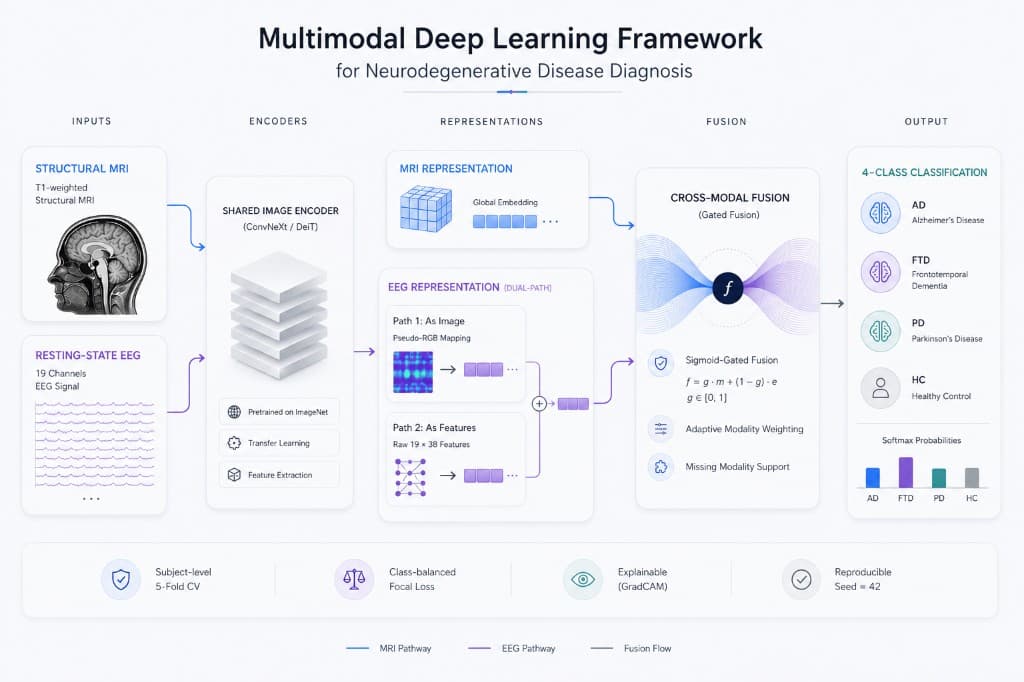
My undergraduate research explored a multimodal framework combining structural MRI and resting-state EEG representations. Cross-modal attention and gated fusion form the connection between the modalities and the classification stage.
03 / The choices behind it
Engineering decisions
Represent each modality deliberately
The architecture separates input representations before fusion, allowing the system to retain the different structure of imaging and signal data.
Learn the connection between signals
Cross-modal attention examines relationships between the representations. Gated fusion controls their contribution to the shared representation.
Consider missing information
Missing-modality support is part of the research design. This work is an experimental machine-learning study, with no claim of clinical validation or deployment.
04 / Looking back
What stayed with me
Research taught me to pay attention to the assumptions around a result: what data is available, what a model can actually support, and what would need to be established before practical use.